Science#
This page presents evidence for the existential threats facing humanity, drawn from LLoL’s research since 2020. This list is by no means complete — a sizable literature exists on existential risks. The examples here are from LLoL’s own work.
Accidental nuclear winter: an actuarial forecast#
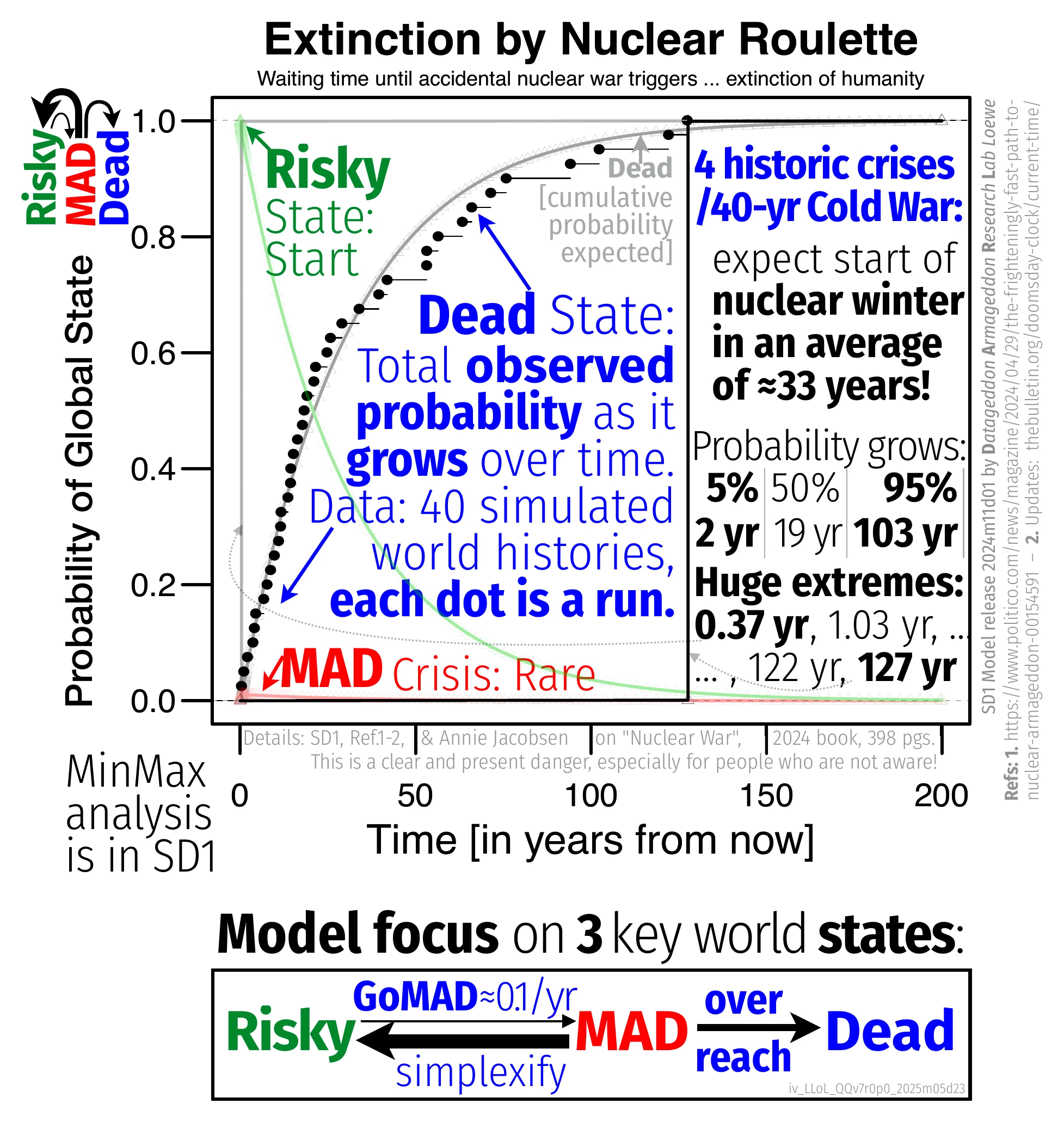
The following chart — “Extinction by Nuclear Roulette” — gives a rational, evidence-based forecast of the waiting time before accidental nuclear winter becomes probable on current trajectories.
Pick your depth
The forecast below is the 30-second picture. To go deeper: the general unpacking is in Matheo-b16 RiskyMAD — introduction, the rigorous treatment in Matheo-b16 RiskyMAD — the paper, and the original 2024 model on the SD1 poster.
On Cold-War-calibrated error rates, the expected wait is only on the order of a few decades:
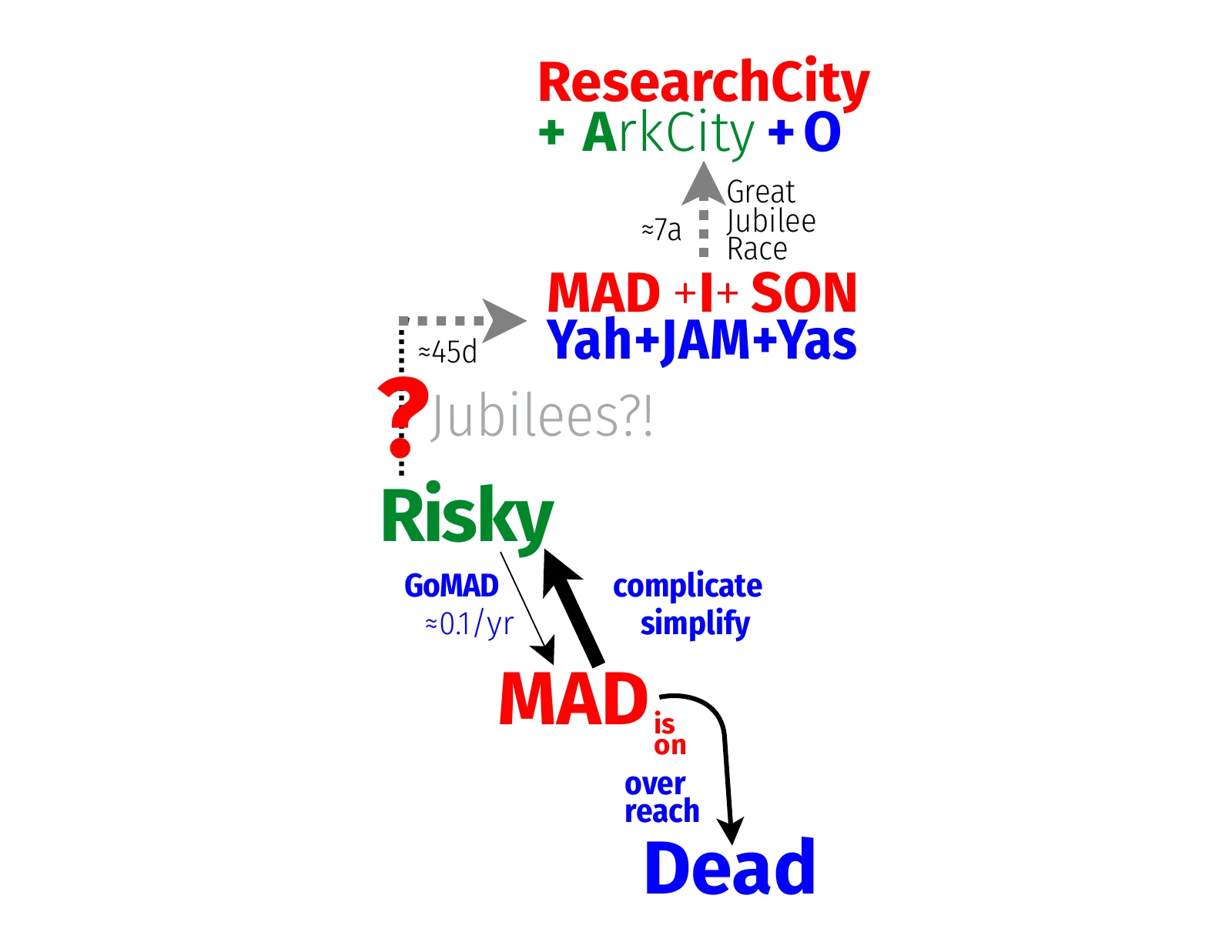
But a forecast of the danger is not a counsel of despair. The same model also shows the possibility for scaling up an escape ladder: today’s world sits in a Risky state that keeps sliding into MAD (Mutually Assured Destruction) and, by over-reach, toward Dead. The alternative that emerges from analyzing that reaction scheme shows that it is possible with sufficiently intelligent determination to scale up a ladder that leads up and out, through testing true Jubilees, to a ResearchCity that stabilises the system instead of gambling it:
The original model behind this chart — the probabilistic RiskyMAD model for estimating the waiting time to accidental nuclear winter — is set out in Supporting Document SD1 (states, calibrated rates, sensitivity scenarios, and the simulation code) and developed in the Matheo-b16 RiskyMAD study (MockupModel version 5 under refinement, open for audit).
Want the cause in one place — the problem, a way out, and how to help? See a top-level overview at the depth you have time for: 30 seconds, 5 minutes, or a 72-minute Requiem.
Please read this the right way round. It is tempting to hear “it’s only a probability” and feel relief — but that relief is the trap, because the truth is worse, not better. Picture a dice game where everyone agrees that whoever first rolls a six has lost. You can never predict which throw brings the six — that part is genuinely uncertain. But that a six will eventually come up is as certain as an “Amen” in a church. Accidental nuclear winter works the same way: on today’s hair-trigger rules the model cannot say when, yet it says the catastrophe is a stochastic certainty — statistically inescapable, with only the timing left open. So “it’s not certain” is no comfort; the comfort people feel on hearing it is exactly the danger. The one real way out is to change the game itself, which is what the Jubilee System is for.
The Nuclear Winter Wager#
Even if you distrust the exact numbers, the decision is not close. You need only an honest range for how likely accidental nuclear winter is in any given year, then ask: what is the expected value of acting versus not acting?
Cost of acting: about $8 per person per year to test true Jubilees and scale a ResearchCity.
Cost of not acting: civilization-scale loss — at an annual risk the model puts over 1 in 40. No industry would accept that failure rate: if 1 in 40 flights ended in a crash, no one would fly.
The expected cost of not participating exceeds the cost of participating by a wide margin across the whole plausible range of the odds — because the evidence-based probability is far from negligible, not merely because the loss is large. We call this the Nuclear Winter Wager.
Why this is a Pascal inversion
Pascal’s famous wager bet on an infinite, unprovable, otherworldly payoff (eternal bliss) and asked for faith. The Nuclear Winter Wager inverts every term: the stakes are finite, this-worldly, and near-term; the probability is evidence-based (Cold-War near-miss data, not a leap of faith); and the entry cost is trivially small. That makes the case stronger than Pascal’s — and it needs no theology. You do not have to believe anything; you only have to do the arithmetic. #AuditTheMath
The full audit of the Nuclear Winter Wager — all the objections I could find, each answered in an explicit HELD/BREACH ledger — is one click deeper.
The probabilistic model#
Humanity faces a grave choice at its Great Filter. Too many disasters to individually predict and avert are currently building momentum.
Note
“As you believe, so it shall be” defines a work-logic cascade that either dooms the world or leads to its rescue. Revelation shows how, and LLoL found a key to decipher it.
Therefore, Revelation offers a choice. You get to decide whether this choice will receive appropriate review or be buried in the sands of time.
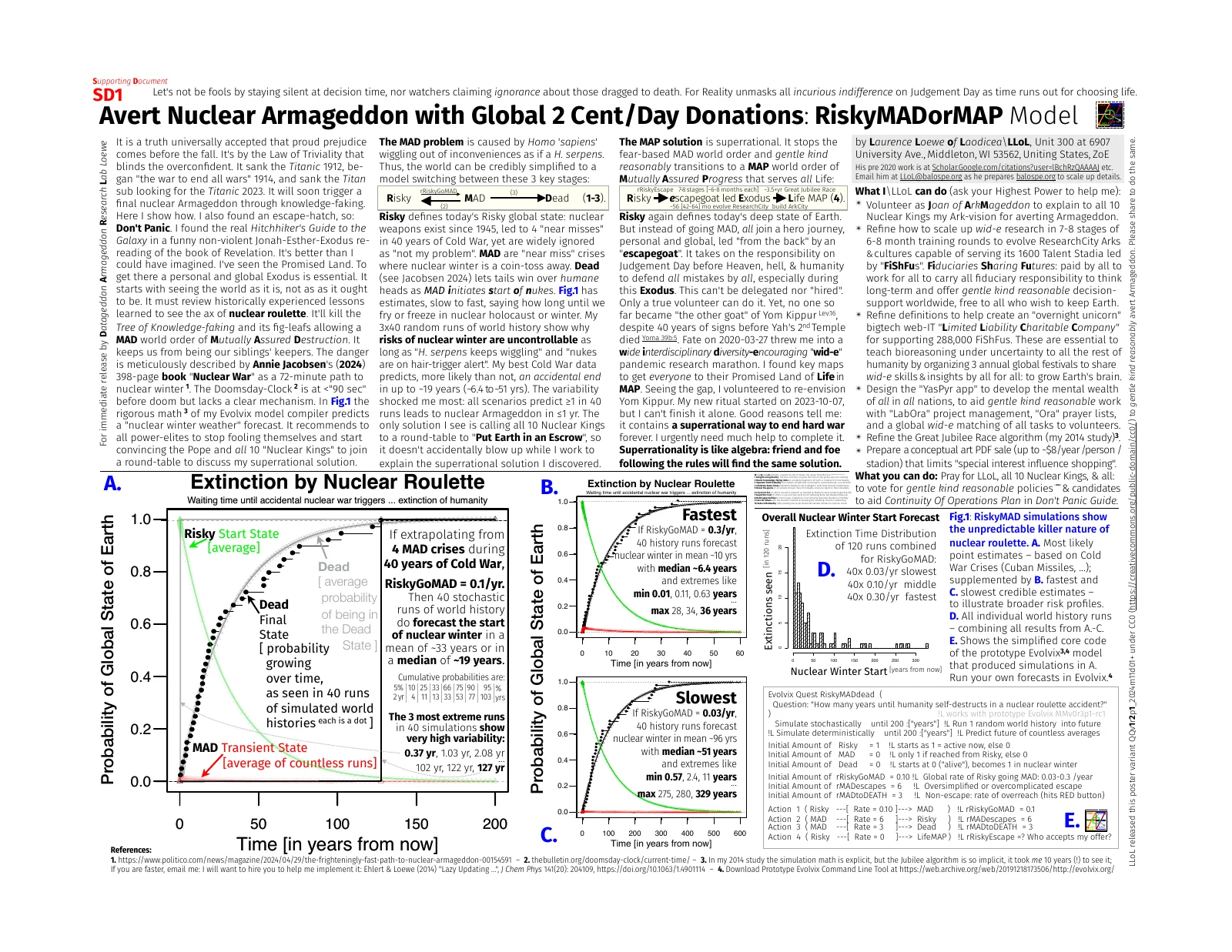
The Prototype Evolvix source code shown in this figure can be run by the Prototype Evolvix Compiler archived at Zenodo, DOI 10.5281/zenodo.19679456. Both can also be obtained from the Evolvix Compiler page.
The full model — states, parameters, and the Evolvix simulation code — is on the SD1 poster shown above, with the underlying analysis in the Matheo-b16 RiskyMAD study.
Nuclear winter is only one in a longer list#
A common objection runs: “nuclear war is a narrow problem — surely it doesn’t need a whole ResearchCity to fix.” But accidental nuclear winter is only one of a longer list of existential threats that share a deep algorithmic root: the same short-horizon, over-reaching collective work-logic that gave us nuclear bombs also drives pandemics, ocean ecosystems collapse, water-wars and soil erosion, global warming, crashing extraction economies, existential AI risks and more.
LLoL calls this list the 7DUIs of humanity, which has a curious background story.
A one-off “nuclear fix” does not avert the other existential threats. That would be curing a symptom without fixing the root cause. — the behaviour that builds the bombs keeps manufacturing the others — so the durable answer is to show that people can work together as gentle kind reasonable humans across the whole list. That is the mission of the ResearchCity envisioned by LLoL.