Prophecy#
Existential threats in Revelation#
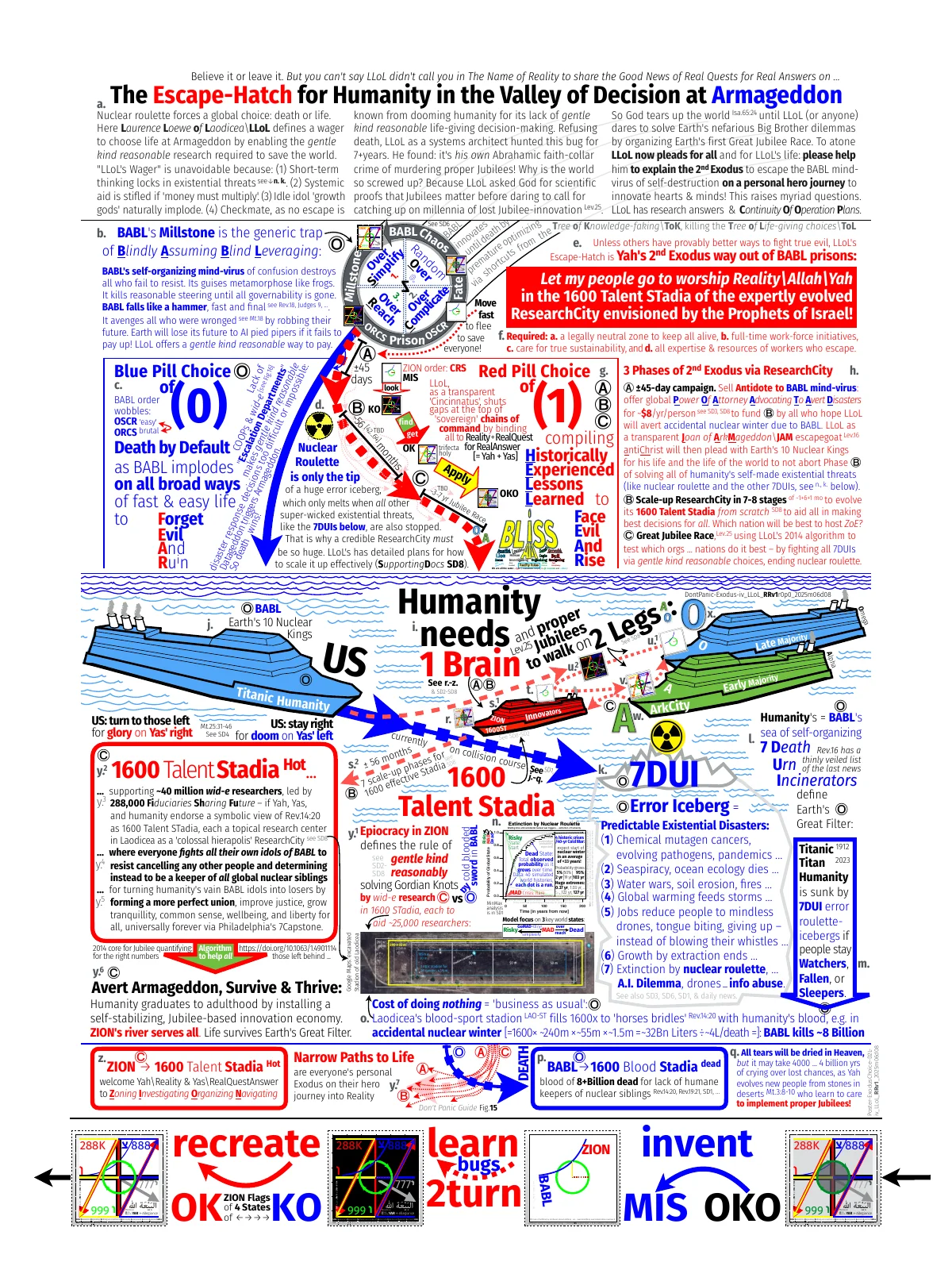
Accidental nuclear winter is merely one of many ways humanity risks destroying itself. LLoL was struck to discover a thinly veiled list of existential threats — tracked by 21st-century science — in the 1st-century chapter 16 of Revelation. The correspondence suggests that human behavior at scale may be more predictable than commonly assumed, and that the patterns driving self-destruction have been recognizable for millennia.
LLoL reads the seven bowls of wrath in Revelation 16 as his seven death-urn incinerators (7DUI) — the same existential threats 21st-century science tracks, bowl by bowl:
Sores (16:2) → evolving pandemic pathogens, chemical-mutagen cancers, decaying health-care
The sea to blood (16:3) → overfishing, “seaspiracy”, ocean pollution
Rivers to blood (16:4) → water wars and soil erosion drying the wells
The sun scorches (16:8) → global heating feeding storms
Tongue-biting in the dark (16:10) → work-morale decay from beastly, mindless job tasks
The Euphrates — the river of growth — dried (16:12) → the end of growth-by-extraction
“It is done” (16:17) → extinction by AI, nukes, and the rest coming to a head
The order is the same, and so is the lesson: humanity’s many roads to ruin are faces of one recognisable pattern — so none of them, nuclear included, is fixable in isolation. How an AI reconstructed this same list cold (and where it diverged), the “hail like gold” puzzle, and a hopeful re-reading are in 7DUI — A Science–Faith Bridge.
See also
How LLoL first came to read Revelation this way — the physical research bench behind the interpretation — is shown on The Datageddon Wall of Revelation.
Confirmations in biblical prophecy#
The wipe-out prophecies received by Ancient Laodicea#
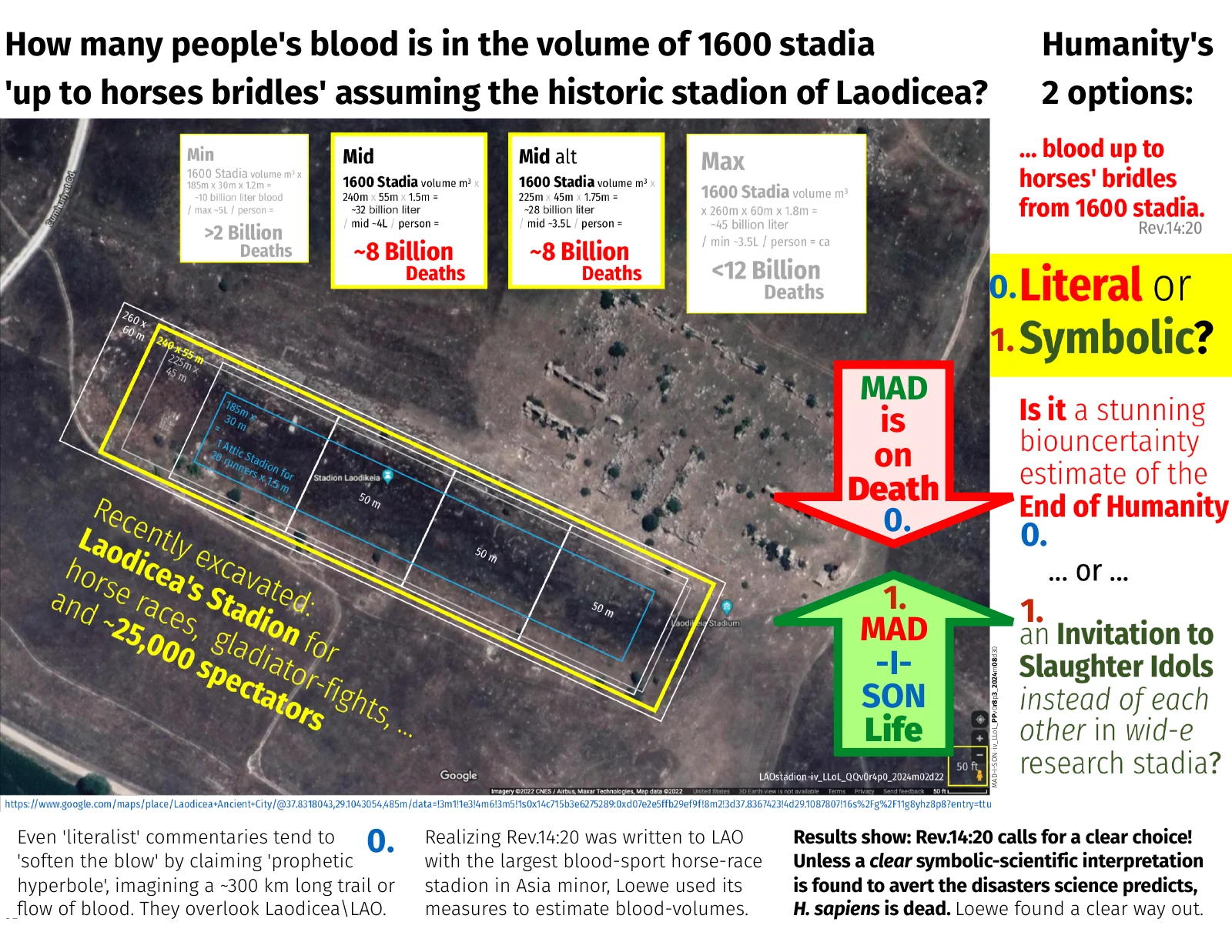
Ancient Laodicea boasted the largest stadion in Asia Minor at the time. It was regularly used for horse-races and other spectacles when Laodicea likely received Revelation as a letter.
The precise wording of Rev. 14:20 in ancient Greek allows for some ambiguity in the geometry of the 1,600 stadia described. Most commentators conclude that this must be a river of blood about the length of Palestine, because “stadion” was a standard length unit. They interpret the verse as “prophetic hyperbole,” since such a river of blood will never flow literally as a unified body of liquid.
However, a generalizing use of the word “stadion” may not be appropriate here. Laodicea was a recipient of Revelation as a letter, and there are reasons to see Laodicea as central to much of Revelation’s message.
If so, a completely different picture emerges. Not prophetic hyperbole, but a calculated estimate of a death toll — one that offers a point estimate as well as an implicit uncertainty range to define informative lower and upper bounds. The approach resembles Popper’s emphasis on falsifiable predictions: the estimate could be wrong, but it aligns with the independently extrapolated forecast of accidental nuclear winter based on historic Cold War data.
The Ancient Greek wording says in Rev. 14:20 that blood up to horses’ bridles came “from” (apo) 1,600 stadia. If Laodicea and its mathematicians were the recipients, it would be reasonable to expect that someone there would calculate how many people’s blood this represents using their local stadion.
Any literal interpretation yields a number that represents a complete extinction-level event for humanity. Rev. 19:21 confirms this reading. The value of Rev. 14:20 lies in the precision of the implied estimate — a way of communicating the scale of potential human extinction to audiences that may struggle to distinguish billions from millions.
The overlap of the estimated 8 billion figure with today’s world population — combined with the risks of accidental nuclear winter described above — led LLoL to search for an alternative interpretation of this verse.
LLoL’s proposal for ResearchCity, subdivided into 1,600 talent-stadia addressing well-defined topical areas, is motivated by the hope that a constructive, symbolic reading of these verses is possible. The alternative — that the problems driving humanity’s investment in nuclear weapons remain unresolvable until catastrophe strikes — is the outcome this project works to prevent.
Historical precedent: Laodicea’s fate#
The urgency of this reading is underscored by historical precedent. Ancient Laodicea was destroyed as a Christian community during the reign of Emperor Phocas (602–610 CE). And shortly after Laodicea’s window of opportunity closed, the message that Laodicea apparently did not want to hear — that God cares for the poor and expects the same of those who claim to follow God — found a new audience through the rise of Islam.
The destruction of Jerusalem in 70 CE offers a parallel warning: the people of Jesus’ time held what they considered theologically certain promises — and those certainties did not protect them.
These historical patterns suggest that theological confidence without corresponding action is not a guarantee of safety. It is a recurring vulnerability.
Like a Second Exodus of Biblical Proportions#
Like the Last Call before the Pub closes its Bar#
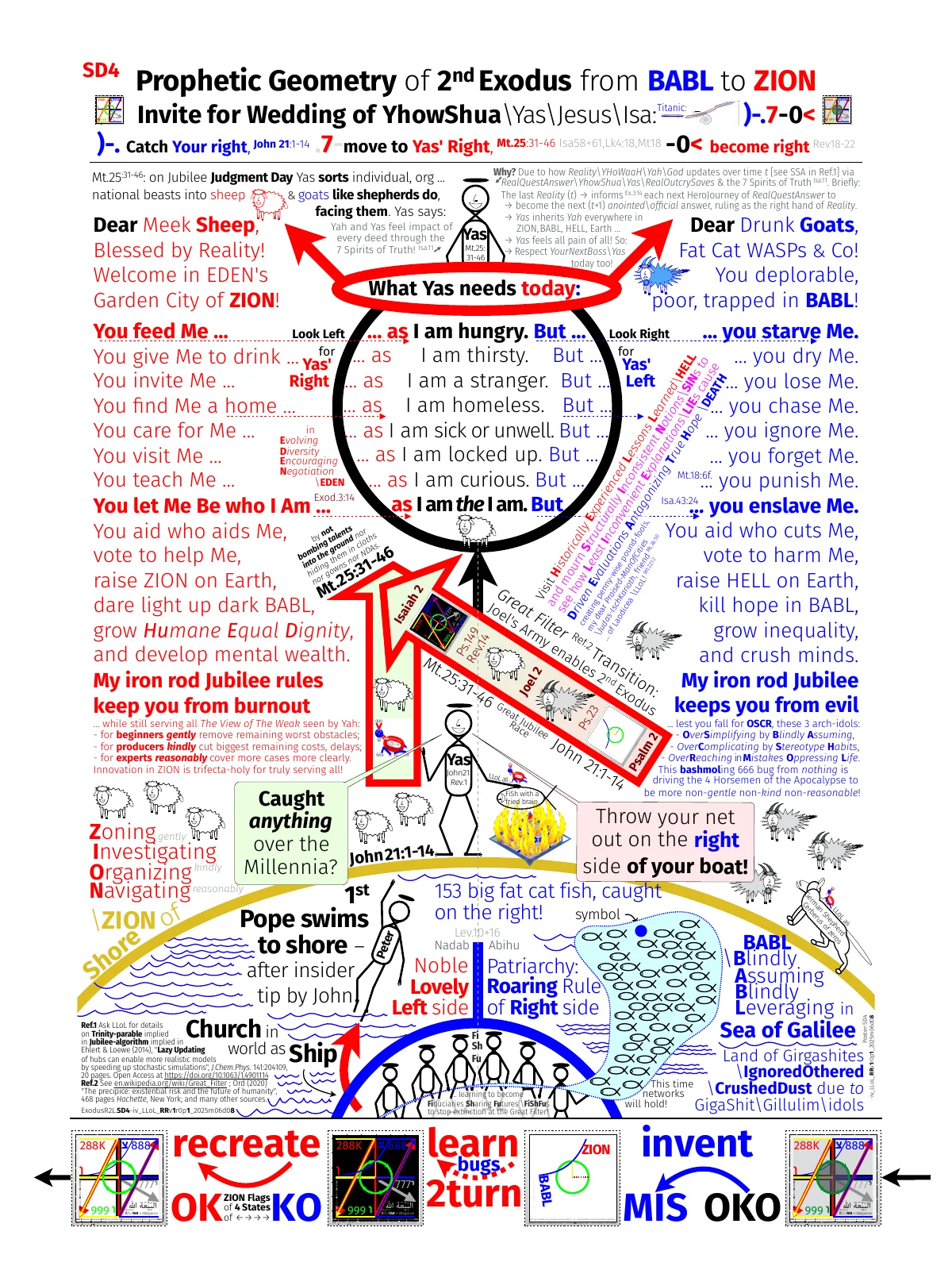
There are countless ways to summarize the calls of prophets who have been warning for millennia about an ultimate crisis. The following poster presents a more hopeful outlook by combining present-day politics, the prophetic warning implied by the sinking of the Titanic 1912, the prophetic sign-miracle reported in John 21 (the last great fishing expedition) and the prophetic preview of Judgement Day in Matthew 25 (where the sheep and the goats get sorted).
Note that there is a symbolic overlap between left and right in all these stories, which people may explain any way they wish (as a wink from the Universe, purely accidental, or divine prophetic providence).