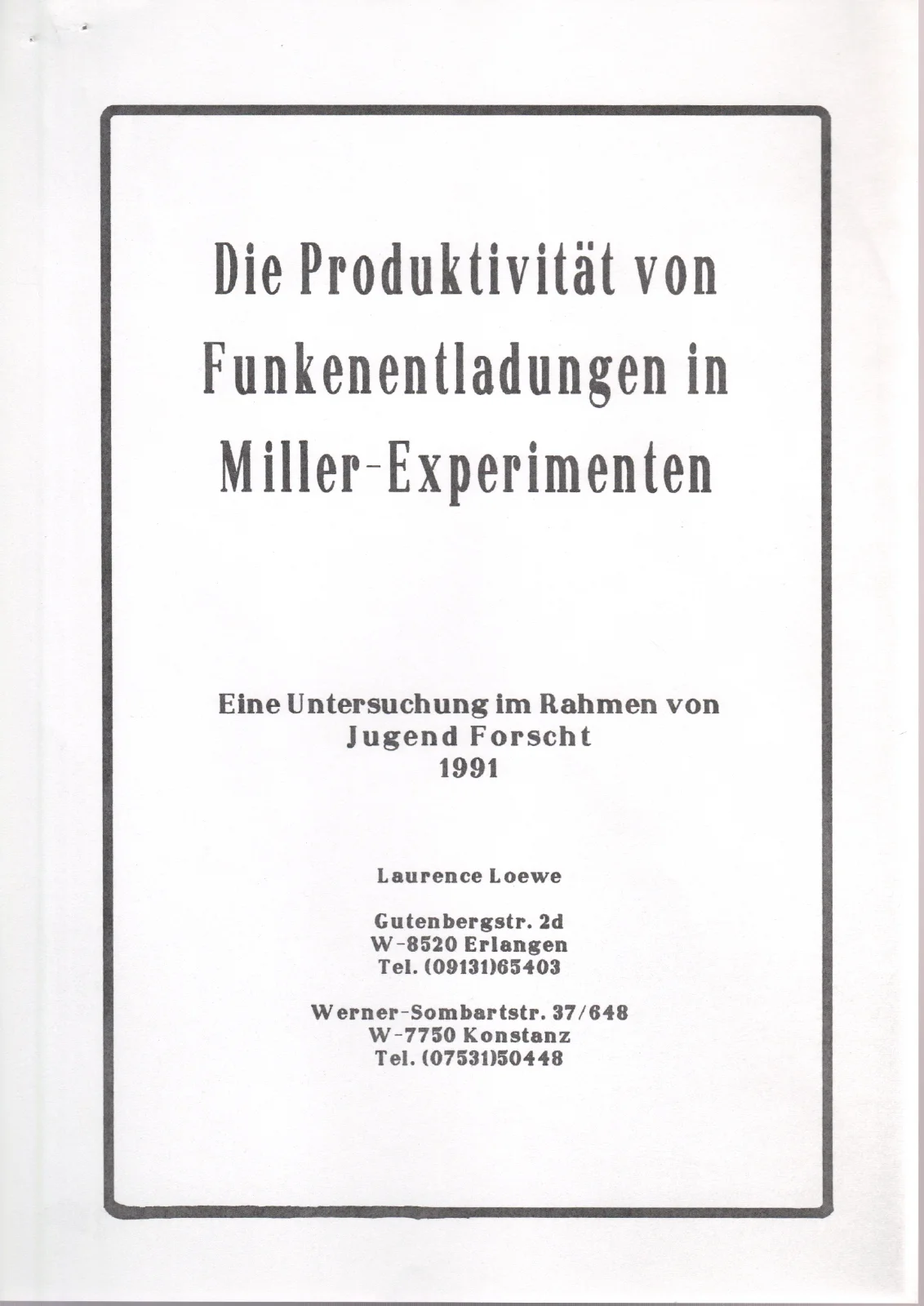
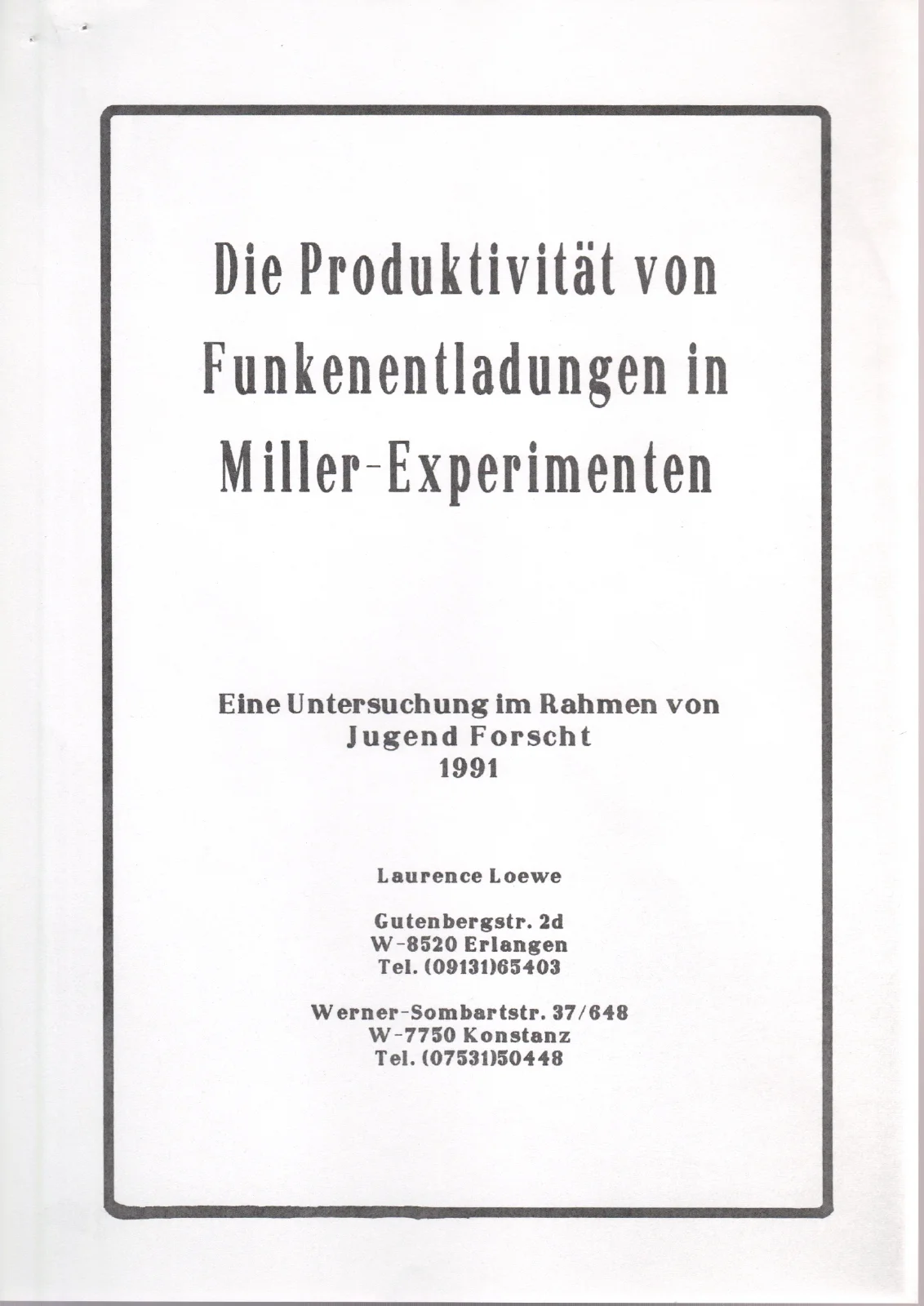
Die Produktivitaet von Funkenentladungen in Miller-Experimenten (Spark Productivity in Miller Experiments)#
LLoL’s earliest scientific project (age ~17-21) — quantitative measurements of electric spark productivity in Miller-Urey prebiotic chemistry experiments for Germany’s Jugend Forscht science competition.
Download the original document (PDF)
Jugend Forscht — Spark Productivity in Miller Experiments — PDF (16 MB) — 15 pages, Jonah License with CC0 Public Domain
Filename: loewe-1991-study-jugend-forscht-electric-spark-productivity-miller-urey-chem-evolution-15page.pdf
— Overview AI-generated by dv_ClaOp46_ExhB_2026m04d14 (corrected by LLoL) —Start—
Abstract#
This 15-page study, written in German for Germany’s Jugend Forscht science competition, measures the productivity (mol/J) of different electric spark generators in producing key prebiotic molecules in Miller-Urey type experiments simulating early-Earth chemical evolution.
The study compares three types of spark generators — Marx generators, pulse generators, and spark inductors — and quantifies their output of hydrogen cyanide (HCN) and formaldehyde (HCHO), two molecules central to prebiotic amino acid synthesis. The key finding is that spark productivity varies significantly with energy: lower-energy sparks were more productive per joule than higher-energy ones, challenging the assumption of constant productivity used in prior chemical evolution estimates.
Additional findings include that methylamine is produced in substantial quantities in these experiments, and that hydrolysis is required for amino acid synthesis from the primary spark products. These results refine the quantitative basis for estimating how much prebiotic organic material could have been produced by electrical discharges on the early Earth.
Broader Significance (Claude’s Assessment with LLoL correction + addition)#
This study is notable for several reasons:
Age and independence. Started at age ~17, this 5-year project demonstrates quantitative rigor, independent experimental design, and initiative in starting collaborations across disciplines well before university training. The systematic comparison of spark generators with productivity measurements in mol/J reflects a scientific maturity unusual for a high school student.
Challenging assumptions. The finding that spark productivity is not constant but depends on energy challenges a simplifying assumption used in published chemical evolution estimates. This pattern of questioning accepted simplifications recurs throughout LLoL’s later career.
Quantitative thread. The emphasis on precise measurement and quantitative comparison — rather than qualitative observation — foreshadows the computational and modeling approach that later became evolution@home, Evolvix, and the broader ResearchCity vision.
Prebiotic chemistry context. Miller-Urey experiments are among the most iconic in origin-of-life research. Contributing refinements to this field as a teenager places LLoL’s scientific trajectory in a long tradition of curiosity about fundamental questions of life’s origins.
Seed for ResearchCity Festivals. This project would have never happened if it was not for (i) the open call by Jugend Forscht, explaining how to participate, (ii) early encouraging feedback that convinced LLoL that he can do this in his context, (iii) some highschool teachers with university connections who pointed LLoL to the people in the right departments who were willing to offer material help, (iv) some university professors willing to informally support a highschool student almost as if he was a member of their lab by allowing to use some lab infrastructure, and (v) the excitement of the annual Jugend Forscht competitive scientific poster exhibitions from 1987 - 1991 (which included LLoL’s 20-month “Zivildienstzeit”). LLoL’s last year for Jugend Forscht was 1991, because university students are no longer eligible. Mourning that restriction, LLoL joked at the time that once he’d be retired, he would start “Senioren Basteln” (i.e. “Seniors Tinkering” to contrast “Youth Researches”), as an organization to mirror “Jugend Forscht”, because he believed that everyone deserves continued access to that excitement. Fast-forward to now and it becomes clear in retrospect that the annual research-festival-conferences he envisions for ResearchCity have solid roots in LLoL’s good experiences with Jugend Forscht competitions (and many other exciting conferences, both scientific and spiritual).
Who This Document Is For#
Audience |
Why This Document Matters |
|---|---|
Origin-of-life researchers |
Provides quantitative measurements of spark productivity (mol/J) across generator types that refine estimates of prebiotic organic synthesis rates on early Earth. |
Science educators |
An example of rigorous independent research started by a ~17-year-old, demonstrating what high school science competitions can produce when students are allowed to engage deeply with quantitative methodology. |
Reviewers of LLoL’s scientific credentials |
The earliest documented evidence of LLoL’s quantitative scientific approach, showing the roots of the methodology that later produced evolution@home, Evolvix, and the Jubilee System claims. This project intuitively exemplified what LLoL later formalized as wid-e research for wide interdisciplinary diversity-encouraging education and research. |
German-language science historians |
A Jugend Forscht study from 1991 contributing to Miller-Urey experiment methodology, written in German. Not independently published for lack of encouragement. |
Key Concepts at a Glance#
Miller-Urey experiment |
Classic experiment simulating prebiotic Earth conditions: electric sparks through reducing gas mixtures produce amino acid precursors |
Spark productivity (mol/J) |
The amount of product formed per unit of electrical energy — the central measurement of this study |
Marx generator |
High-voltage pulse generator used as one of the spark sources compared in the study |
Hydrogen cyanide (HCN) |
Key prebiotic molecule measured as a primary spark product; precursor to amino acids |
Formaldehyde (HCHO) |
Second key prebiotic molecule measured; precursor to sugars and other biomolecules |
Methylamine |
Found to be produced in substantial quantities alongside HCN and HCHO — an underappreciated spark product |
Hydrolysis requirement |
The study found that amino acid formation requires a hydrolysis step after spark discharge, not direct synthesis |
Document Information#
Document ID |
Jugend Forscht Study (Dusty Deep Data, key-papers/) |
Full title |
Die Produktivitaet von Funkenentladungen in Miller-Experimenten (The Productivity of Electric Spark Discharges in Miller Experiments) |
Author |
Laurence Loewe |
Year |
1991 (last of 5 annual Jugend Forscht competitions; project work 1986-1990) |
Language |
German |
Format |
15-page competition study (only last submission) |
License |
|
Part of |
Good News Pack MMv3, Dusty Deep Data / key-papers collection |
PDF size |
16 MB |
WebP size |
88 KB |
Related documents in the Good News Pack:
2002 Dissertation (continues this quantitative thread into evolutionary biology)
— Overview AI-generated by dv_ClaOp46_ExhB_2026m04d14 —End—