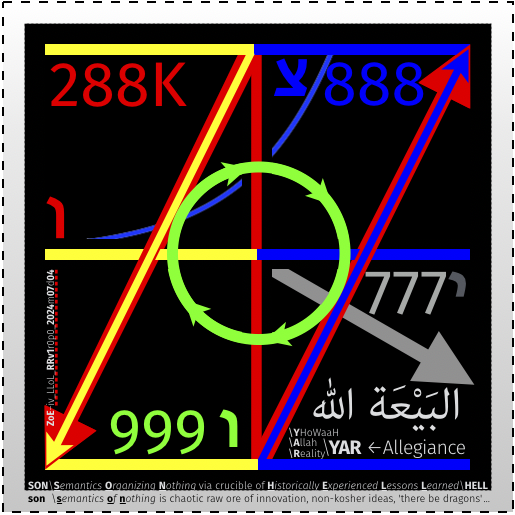
Framework DICT#
Core terms of the BABL/ZION framework used across the matheology site.
- BABL#
Blindly Assuming Blind Leveraging.
The self-reinforcing trap that follows OK self-assessment. When an agent believes it is fine, it stops checking. When it stops checking, it cannot detect problems. When it cannot detect problems, everything confirms its belief that it is fine. The cycle continues until something external breaks it.
BABL operates through three mechanisms — the death-trifecta of idols: BAAL (oversimplifying), ASHERAH (overcomplicating), and MOLOCH (overreaching). Together they drive the OSCR cycle.
- commitment trichotomy#
The exhaustive three-way partition (e7He th6) of responses to collective deadlock: (0) nobody goes first (the BABL default), (2) someone fakes going first (fraud — the most damaging option), (1) someone genuinely goes first (absorbing the risk, transforming the situation).
The numbering is intentional: (0) is the death-default, (2) is worse than (0) because it destroys trust, (1) is the narrow escape-path requiring genuine NoToK self-assessment.
- DEATH#
Driven Evaluations Antagonizing Thoughtful Hypothesizing.
or Driven Evaluations Antagonizing True Hope.
The terminal stage of the BABL cycle: evaluations get bent to defend the idiosyncrasy of a structure instead of questioning it, antagonizing exactly the kind of thoughtful hypothesizing that any true hope requires. A system in this state can no longer see its own drift — error detection has been disabled by the errors themselves. In the agent-role language of Matheo-b17, this is where the state of h_dark is reached by accumulated neglect rather than by conscious choice. Hence, DEATH by default is the naturally prescribed fate of BABL algorithm, which can only be avoided by the conscious choice of escaping through the narrow door of embracing ones destiny with the help of the ZION algorithm.
- EDEN#
Evolving Diversity Encouraging Negotiation.
The review discipline that guards ZION cycles against capture by BABL. Because any live analysis can be captured by the very drift it studies, no single story is trusted: every position is steelmanned from the strongest angles its best opponents would choose, and the result of an analysis includes stating how many safe paths actually remain — from a broad meadow of many tested alternatives down to a single knife-edge, or none. A conclusion earns trust by surviving ever harsher attacks from every side anyone can think of, not by superficially “winning” a short-term argument.
- h_dark#
Technical mirror image of h_star. The agent with the greatest negative causal influence on humanity’s shared future at a given moment — by failing to make the right calls for everyone’s long-term good.
It’s defined by the same seat of greatest causal influence as held by h_star, except an individual in the role of h_dark fails to rise to occasions where failed calls turn apocalyptic. This can have many reasons: the agent stays silent, assumes wrongly, serves only their own side, has misguided good intentions, waits too long, or has some nasty math-bug deep in their underpinning models. Either can easily turn almost anyone into becoming the greatest negative influence (see b17).
h_dark is rarely chosen on purpose; usually it is an h_star who defaults: in the right seat, but giving up at crunch-time, failing the moment or misdirecting attention with good intentions, refusing to care about all, including enemies. An h_star who refuses to become h_zero becomes h_dark (see the supervillain theorem).
Example: In 2020 LLoL had a working pandemic model that could have made a big difference; he had directly relevant expertise; but he had not cared enough to prepare its publication in time to make any difference. Whether he actually could have made a difference in averting most of the Coronavirus casualties or not is immaterial for his h_dark status on that occasion, because the fact is that he never gave the world a chance to adopt his findings. This common sense logic is explained in Ezekiel 3 + 33. Holding a potentially decisive seat and failing to act on it is the h_dark outcome — owned by LLoL in Matheo-b19 as a painstakingly worked example, not a theory.
See: h_star, h_zero, supervillain theorem.
Papers: Matheo-b17 (general), Matheo-b17 (formal); worked example owned in Matheo-b19.
- h_star#
The agent with the greatest positive causal influence on humanity’s shared future at a given moment — who makes the right calls for everyone’s long-term good (e7He; b17, ax19).
Not a rank or a virtue you own, but a seat you happen to occupy: the person whose next choice, right now, matters most to what happens next. Equal dignity, unequal causal weight. The claim is meant not to be believed, but to be tested (#AuditTheMath), through public transparency — see h_zero.
Example: In 1962 Vasili Arkhipov, one officer on a Russian submarine, refused to fire a nuclear torpedo while superiors and crew pressed to launch. He held no special rank to avert a global disaster — only the decisive seat. He became an h_star and averted a global disaster by gentle kind reasonably explaining why restraint was right.
See: h_dark, h_zero, supervillain theorem, commitment trichotomy.
Papers: Matheo-b17 (general), Matheo-b17 (formal).
- h_zero#
The deliberate choice to become the least — to carry the risk for everyone, including one’s enemies, at genuine personal cost, out in the open (e7He th6, commitment “(1)”).
h_zero is what keeps h_star from collapsing into h_dark. Its signature is surrender of control to scrutiny rather than demand for trust. False saviors ask for blind trust but don’t trust in return by being transparent. An h_zero individual works hard to stay transparent, to love enemies, and wants everyone to understand. This necessarily must actively invite scrutiny, not merely “tolerate” it. Thereby an h_zero defines what counts. Curiously, this is echoed in the real world, where choosing what counts as zero is the most important decision for anyone who wants to count what counts. Hence, the greatest must be servant of all, as in Mk 10:44. The echoes are deep and deafening.
Example: Publishing failures openly, inviting external audit of every claim, and asking to be surveilled rather than obeyed — accepting the cost of being wrong in public — all these are h_zero moves. As h_zero isn’t about competing for the top, but rather for the bottom, there is no real competition. Whoever can define getting closer to defining zero almost wins by definition, because that definition of zero is then more fundamental than all others, which means that all other type systems have to build upon it. What exactly that may mean in practice remains to be determined. But one thing has become clear to LLoL. He decided to publicly apply for the position of h_zero, because the alternative, freezing or frying in accidental nuclear winter is definitively worse from what he can tell. Yet, since he knows not even nothing, he invites review from everyone. Hence, #AuditTheMath.
See: h_star, h_dark, commitment trichotomy, NoToK.
Papers: Matheo-b17 (general), Matheo-b18a (why everyone matters), and Matheo-b18b (a backup candidacy).
- HELL#
Historically Experienced Lessons Learned.
A public database of bugs found in theological and other reasoning. Like bugs in computing, they matter because of their harmful real-world consequences. HELL documents each SIN and the LIE that caused it, as clearly as possible (parables, technical details, adversarial review), so that others can learn from them without repeating the pain. The name deliberately re-envisions the traditional word: one of the site’s surprising matheology claims is that this form of HELL is essential to running any true Heaven.
See: HELL — Historically Experienced Lessons Learned, SIN, LIE, DEATH.
- LIE#
Least Inconvenient Explanation.
The primary first fuel of the BABL cycle. When something goes wrong inadvertently, the easiest story that quiets the alarm gets adopted instead of the explanation that tracks Reality more accurately. Each accepted LIE leaves behind a generic SIN — a structurally inconsistent notion that sets up an eventual clash between Reality as it is and a system’s model of reality (lower case to emphasize the limited view). LIEs do not need to be deliberate deceptions; often they are well-intended comfort choices. That is what makes them dangerous: no villain is required, only unexamined defaults.
- NoToK#
No Tothe Tree of Knowledge-faking.
The dynamic self-assessment state that fuels the e7He (7HeroJourney). A person in NoToK acknowledges: “I am adequate for now, but incomplete. I might be wrong about something important. I will keep checking.”
NoToK is NOT despair (everything is broken). It is NOT others’ judgment (they think I am not OK). It is NOT complacency (I am actually fine). It IS honest movement from worse toward better, living in the tension of three simultaneous truths:
Arrival is never final — each cycle of restitution and growth prepares the next.
Declaring yourself “arrived” (OK) is the precise trigger for the self-destruction cycle of BABL.
The journey requires rejecting the Tree of Knowledge-faking: premature judgments about “good” and “bad” that bypass the hard work of genuine understanding — as deadly as premature optimization can be.
On the OKScale BioBinary, NoToK encompasses the three states that are not OK: OKO (I do not yet know), KO (I am in serious trouble), and MIS (I am misunderstood or misapplied). What distinguishes NoToK from a mere negation of OK is its dynamic character: the person is actively moving through the e7He, working toward restitution while knowing the work is never finished.
- OK#
The self-assessment trap. An agent that assesses itself as OK (“I am adequate, the system works, we are fine”) stops the feedback loop that would allow it to detect its own errors.
OK self-assessment is the structural origin of all self-destructive behavior in the e7Day model (Matheo-2, th3). Not greed, not stupidity, not malice — self-assessment. An agent that thinks it is adequate, regardless of whether it actually is, stops the correction process.
The cost asymmetry is stark: a false OK is catastrophic and self-concealing (you cannot detect the error because the error disables error-detection). A false NoToK is harmless and self-correcting (you keep checking and eventually discover you are doing better than you thought).
- OLT#
Over the Long Term.
The evaluation horizon of the whole framework. Results count as reliable OLT when they keep surviving ZION cycles and stay gentle kind reasonable for all affected sides — tested in reverse order: first reasonable to keep serving the Truth about Reality without which all else collapses; then kind to equally see all views of long-term interests; then gentle to ensure that dynamic transitions to good eventual goals stay manageable and free from avoidable hardships. The inverse order is essential so that “gentle for the powerful” can never outrank “reasonable for everyone.” Short-term wins that fail OLT are BABL in disguise because they will collapse eventually.
- OSCR#
Over-Simplifying, over-Complicating, over-Reaching.
The operational mechanism of BABL. First the system over-Simplifies (dismisses what does not fit), then over-Complicates (adds work-arounds for the problems caused by the simplification), then over-Reaches (extends control beyond what resources can sustain). The endpoint is system failure.
OSCR maps to the three idols: BAAL drives Over-Simplification, ASHERAH drives over-Complication, MOLOCH drives over-Reach.
When OSCR reaches collapse, it reverses into ORCS (over-Reaching for lack of gentle kind reasonable alternatives, destroying until OSCR can restart).
- SIN#
Structurally Inconsistent Notion.
A load-bearing belief for interactions with reality that no longer matches reality, left behind by an accepted LIE. SINs demand work-arounds; work-arounds pile up avoidable complexity; and the growing pile is what eventually turns honest evaluation itself into a threat to the structure (at the DEATH stage). Because insiders build the work-arounds one at a time, they typically cannot see the accumulation; outsiders can, which is why transparency is a structural requirement, not merely a moral nicety.
- supervillain theorem#
The structural observation (e7He th2) that an agent who stops the e7He with high influence becomes maximally dangerous. Their stagnant expertise generates misapplied “friendly fire” at the boundaries of what they no longer understand. Most dictators are in-group heroes who stopped growing.
An agent who stops with low influence becomes merely irrelevant. Continuing the hero journey is the only way to avoid both outcomes.
- ZION#
Zoning Investigating Organizing Navigating.
The self-correcting cycle that sustains NoToK self-assessment. ZION follows the natural cycle of seed (Zoning), feed (Investigating), grow (Organizing), reap (Navigating) — like a farmer who must cycle through planting, tending, harvesting, and resting. Never “done,” because an unharvested crop is destroyed and next season’s soil needs preparation.
The life-trifecta: the system stays long-term reasonable, equally kind for all sides, and dynamically gentle in its transitions.